How to Carry a Surfboard Safely
How to Carry a Surfboard Safely
You’ve just bought your first surfboard. It’s enormous, it’s awkward, and you’re standing in the car park at Croyde or Polzeath wondering how on earth you’re supposed to get it down to the water without taking out a row of strangers. Don’t worry — every surfer has been exactly where you are right now. Carrying a surfboard is one of those things that looks deceptively simple from a distance but requires a bit of know-how to do properly. Get it wrong and you risk damaging your board, injuring yourself, or — perhaps most painfully — embarrassing yourself in front of a beach full of people who’ve been doing this for years.
The good news is that once you’ve learned the basics, it becomes second nature. This guide walks you through everything you need to know: how to carry your board on land, how to handle it in the water, how to manage it on windy days (and if you’ve ever been to a British beach in October, you’ll know that windy days are very much the norm), and how to be considerate of the people around you while you’re doing it. Safety and etiquette go hand in hand in the surf community, and getting both right from the very beginning will make you a more confident, capable, and welcome presence in the water.
Understanding Your Board Before You Pick It Up
Before we get into technique, it helps to understand what you’re actually dealing with. As a beginner, you’re almost certainly riding a longboard or a foamie — a soft-top board that’s typically somewhere between 7 and 9 feet long. These boards are brilliant for learning because they’re stable and forgiving, but they’re also bulky and can act like a sail in the wind. A standard beginner soft-top board can weigh anywhere between 4 and 7 kilograms, which doesn’t sound like much until you’re carrying it 400 metres across a car park and down a sandy path with a 20mph onshore wind trying to rip it out of your hands.
UK surf schools and hire shops — places like Escape Surf School in Newquay, Big Blue Surf School in Croyde, or Gower Surf School in Wales — will often give you a quick tutorial on board handling before your first lesson. Pay attention to this. It might feel like filler before the fun stuff, but it’s genuinely useful information. If you’ve bought your own board from somewhere like Osprey, Decathlon, or a local surf shop such as Fistral Beach Surf Shop in Cornwall, ask the staff for advice before you leave. Most are more than happy to help.
The Basic Carry: Under Your Arm
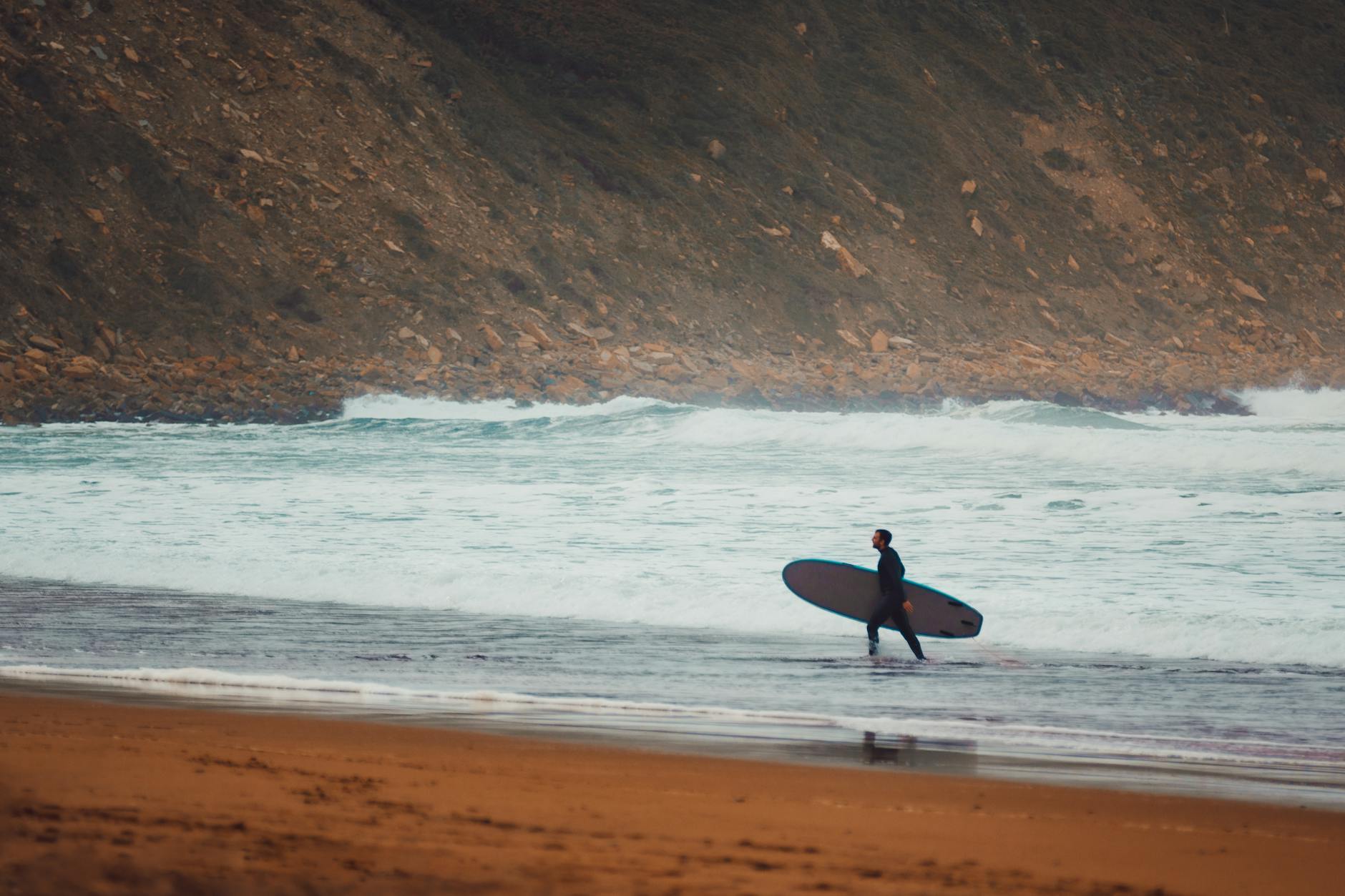
The most common way to carry a surfboard on land is tucked under one arm, with the board running parallel to your body and the nose pointing forward. Here’s how to do it properly:
- Stand beside your board with it lying flat on the ground, fins facing up (this protects your fins from damage and means the wax side — the deck — is facing down, away from grit and stones).
- Crouch down and grip the rail — that’s the edge of the board — roughly in the middle, where the board is widest.
- Lift the board and tuck it under your arm so that the rail sits in the crook of your elbow and forearm. Your hand should wrap around the rail on the far side.
- Keep the nose pointing forward and slightly angled down. This gives you better control and stops the wind catching it like a kite.
- Walk with confidence — a hesitant, jerky walk makes the board harder to control. Smooth and steady wins every time.
This method works well for shorter distances, but if you’ve got a long walk ahead of you, your arm will tire quickly. Swap sides every few minutes to distribute the strain. Your fins will be pointing outward away from your body, which is worth being aware of — those things are sharp, and jabbing a passing dog walker is not the introduction to the surfing community you want to make.
The Head Carry: For Longer Distances
For longer treks down to the beach, consider carrying the board on your head. It sounds precarious but it’s actually more comfortable and less physically taxing than the under-arm carry, particularly with bigger boards.
Place the board flat on your head, deck facing down, with the centre of the board balanced across the top of your skull. Use both hands to grip the rails on either side to stabilise it. The nose should point forward. This method distributes the weight much more evenly and frees up your arms, which is handy if you’re also lugging a bag, wetsuit, or a thermos of tea — because this is Britain, and a thermos of tea is always relevant.
The head carry does require a bit of practice to feel comfortable. Your neck muscles will adapt over time. In the meantime, use a folded towel or a neoprene board bag between your head and the board to cushion the weight and protect both you and the board’s surface from unnecessary wear.
Using a Board Bag or Carry Strap
If you’re planning to surf regularly — and once you’ve caught your first wave, you almost certainly will be — it’s worth investing in a board bag or a carry strap. A day bag (sometimes called a day sock or a travel sock) is a thin, lightweight cover that protects your board’s wax from the sun, stops the fins from snagging on things, and makes the board a little easier to grip. Brands like FCS, Dakine, and Creatures of Leisure all produce solid options, and you can pick them up from most UK surf shops or online retailers like Shore.
Carry straps are even simpler — a padded strap that loops around your board so you can carry it over your shoulder like a bag. They’re inexpensive (usually between £10 and £25), easy to use, and make a real difference on longer walks. If you’re parking at one of the larger Cornish beach car parks — think Fistral or Perranporth — where the walk to the water can be significant, a carry strap is worth every penny.
Managing Your Board in the Wind
British surf spots are not known for their gentle, balmy conditions. If you’re surfing in Cornwall, Devon, Wales, or anywhere along the north-east coast, you will encounter wind. Strong wind and a large flat board are a genuinely hazardous combination. The board can be caught by a gust and wrenched out of your hands before you have time to react, and a flying surfboard is a serious danger to anyone nearby.
A few habits will help you stay in control on blustery days:
- Always carry the board with the nose pointing into the wind, not away from it. If the wind gets under the nose, it will try to flip the board up and over. Keeping it facing into the wind reduces the surface area the gusts can catch.
- Lower your centre of gravity slightly by bending your knees when a strong gust hits. This keeps you stable and stops the board from pulling you off balance.
- On very windy days, keep the board close to your body rather than extended outward. The closer it is to your centre of mass, the easier it is to control.
- If you need to stop and adjust your grip or check your leash, turn your back to the wind and crouch down. Use your body as a windbreak.
- Be especially cautious in car parks and narrow paths where the wind can funnel and create unexpected strong gusts. Keep the board away from parked cars, other people, and children.
Carrying Your Board Safely Around Other People
This is where safety and etiquette start to overlap. A surfboard is a large, solid object and it can cause serious harm if you’re not paying attention to your surroundings. Whether you’re walking through a busy beach car park, along a coastal path, or through a surf school area, you need to be switched on.
Always carry the board fins-back when walking through crowds, so the tail (and the fins) are behind you rather than at face height in front. Announce yourself verbally if you need to pass someone in a tight space — a simple “excuse me, board coming through” is all it takes. People appreciate the heads-up far more than a fin in the ear.
Keep a particular eye out for children. Kids at the beach are unpredictable — they run, they double back, they crouch down to look at things at exactly the wrong moment. Slow down whenever children are nearby, and if the path is genuinely too crowded to pass safely, wait. There’s no wave worth rushing for that justifies knocking a child over with a 9-foot foam board.
On the beach itself, try to walk around groups of sunbathers and families rather than through them. If you’re heading to and from the water at a busy spot like Newquay’s Fistral Beach during summer, stick to the edges of the beach where foot traffic is lighter. This also keeps you away from the designated swimming areas, which is important for everyone’s safety.
Getting to and from the Water
Once you’re at the shoreline, the way you handle your board changes. The ocean has its own ideas about where your board should be, and you need to be one step ahead of it.
As you approach the water, keep your board under your arm or at your side — don’t drag it across the sand. Dragging damages the fins, scratches the underside of the board, and grinds sand into the wax on the deck, which reduces its grip. It’s also just a bit of a giveaway that you haven’t done this before.
At the water’s edge, attach your leash to your back ankle before you go in. The leash connects your ankle to the board via a cord, and it is non-negotiable. Without it, a wipeout can send your board flying toward other surfers or swimmers. Most UK surf schools will insist on this, and for good reason. Make sure the leash is attached securely — give it a firm tug to check — and that the cord runs up the back of your leg rather than around the front, which can trip you up.
When you enter the water, hold the board to your side with both hands on the rails, and walk in perpendicular to any incoming waves where possible. This reduces the chance of a wave catching the board broadside and slamming it into you. When a wave comes, lift the nose of the
board and push through the whitewater, or if the wave is too powerful, turn the board side-on and let it absorb the impact rather than fighting it head-on. Once you are past the break, you can paddle out with more confidence, keeping your weight centred and your eyes on what is coming from the horizon.
On the beach itself, always be conscious of where your board is pointing. Carry a shortboard under your arm with the fins facing away from other people, and hold it close to your body rather than letting it swing out. With a longboard, the over-the-head carry is often the most practical option on a crowded beach — rest the board flat on your head with both hands gripping the rails, and keep your elbows slightly bent to absorb any wobble from the wind. In gusty conditions, which are hardly uncommon on a British coastline, a longboard carried overhead can act like a sail, so be ready to drop to a side carry if a strong gust catches you off guard. Always check behind you before turning around, as the tail or nose of the board can swing into someone at head height without you realising.
It is also worth thinking about the surface you are walking on. Wet rock, slipways, and the compacted sand near the waterline can all be treacherous underfoot, so take short, deliberate steps rather than striding out. If you are carrying board and wetsuit bag at the same time, consider making two trips rather than overloading yourself and losing control of the board. A dropped board on rock or a crowded beach is at best an embarrassing dent and at worst a serious injury to someone nearby.
Carrying a surfboard safely is not complicated, but it does require a small amount of thought each time. The right technique varies depending on board size, wind, terrain, and how busy the beach is, so stay aware of your surroundings and adjust accordingly. With a bit of practise, it becomes second nature — and keeping yourself and those around you safe is as much a part of surf culture in the UK as reading the swell or waxing your board.