Surfing for Over 40s: Is It Too Late to Start?
Surfing for Over 40s: Is It Too Late to Start?
Alan didn’t own a wetsuit until he was 43. A secondary school teacher from Harrogate, he’d spent most of his adult life convinced that surfing was something you did in your twenties, preferably with sun-bleached hair and a van. Then his daughter dragged him to a beginners’ lesson at Saunton Sands in Devon during a half-term break, and everything changed. Within eighteen months, he was booking solo surf trips to the Gower Peninsula and waking at 5am to check the tide tables. “I genuinely thought I’d missed the boat,” he told me. “Turns out I’d just missed a few waves.”
Alan’s story isn’t unusual. Across the UK, men and women well into their forties, fifties, and beyond are discovering surfing for the first time, and they’re finding that the sport isn’t nearly as age-restricted as its cultural image suggests. This guide is for anyone who’s looked at the waves and wondered whether they’ve left it too late. The short answer is no. The longer answer is what follows.
Why Over 40s Actually Have an Advantage
There’s a persistent myth that surfing is purely a young person’s game — that if you haven’t learned to pop up on a board by the time you’re twenty-five, your window has closed. This isn’t just wrong; in several meaningful ways, it’s the opposite of the truth.
Older beginners tend to be more patient. They’re better at listening to instruction, more willing to spend time on the basics, and less likely to rush ahead before they’re ready. The teenage surfer who’s desperate to look cool in front of their mates will paddle out before they can read a wave. The forty-something who’s taken up surfing because they genuinely want to learn will spend an hour practising their pop-up on the beach without embarrassment. That attitude is worth more than youth and flexibility combined, at least in the early stages.
There’s also the matter of focus. When you’re older, you tend to know yourself better. You understand how you learn, when you’re tired, and when you’re pushing too hard. These are genuinely useful skills in a sport where overconfidence can get you into trouble.
That said, honesty matters here. Your body at 45 is not the same as it was at 22. Recovery takes longer. Flexibility may be reduced. You might find the paddle-out more exhausting than expected. These are real considerations, not reasons to stay on the beach, but things to factor into how you approach the early weeks of learning.
What the UK’s Surf Scene Actually Looks Like
Britain has a genuinely world-class surf coastline, though you wouldn’t always know it from the cultural conversation around the sport. The south-west is the obvious starting point. Cornwall alone has more than a dozen surf schools operating on beaches that receive consistent Atlantic swell, with spots like Fistral in Newquay, Croyde in north Devon, and Perranporth offering reliable beginner-friendly conditions for much of the year.
But Cornwall isn’t the whole picture. The Gower Peninsula in South Wales has been a beloved surf destination for decades, with Llangennith offering long, rolling waves that are forgiving for learners. Pembrokeshire, further along the Welsh coast, has some genuinely stunning surf beaches. In Scotland, Thurso East has hosted professional competitions, and the beaches around Dunbar in East Lothian provide accessible options for beginners in the north. Even Yorkshire’s Scarborough and Filey have a small but devoted surf community. The UK’s surf scene is broader and more geographically spread than most people realise.
For a first lesson, a surf school affiliated with Surfing England, Surf Wales, or Surfing Scotland is strongly recommended. These national governing bodies accredit coaches and set safety standards, which matters considerably when you’re a beginner learning to manage yourself in the ocean. The British Surf Association also offers useful guidance on finding qualified instruction.
Your First Lesson: What to Expect
Booking a beginner’s group lesson typically costs between £35 and £55 per person at most UK surf schools, and that usually includes wetsuit hire, board hire, and two hours of instruction. Schools such as Escape Surf School in Newquay, Gower Surf School in Wales, and Momentum Surf School in Cornwall are well-regarded options with experienced coaches used to teaching complete beginners of all ages.
Here’s what a typical first session looks like:
- Land-based warm-up and technique. Before you go anywhere near the water, your instructor will take you through the basic movements on the sand. You’ll practise your pop-up — the motion of going from lying flat on the board to standing — repeatedly until it starts to feel natural. This isn’t wasted time. It’s the most important part of the lesson.
- Ocean safety briefing. You’ll learn about rip currents, how to fall safely, how to hold your board in the surf, and basic ocean awareness. Pay close attention. This is genuinely important information.
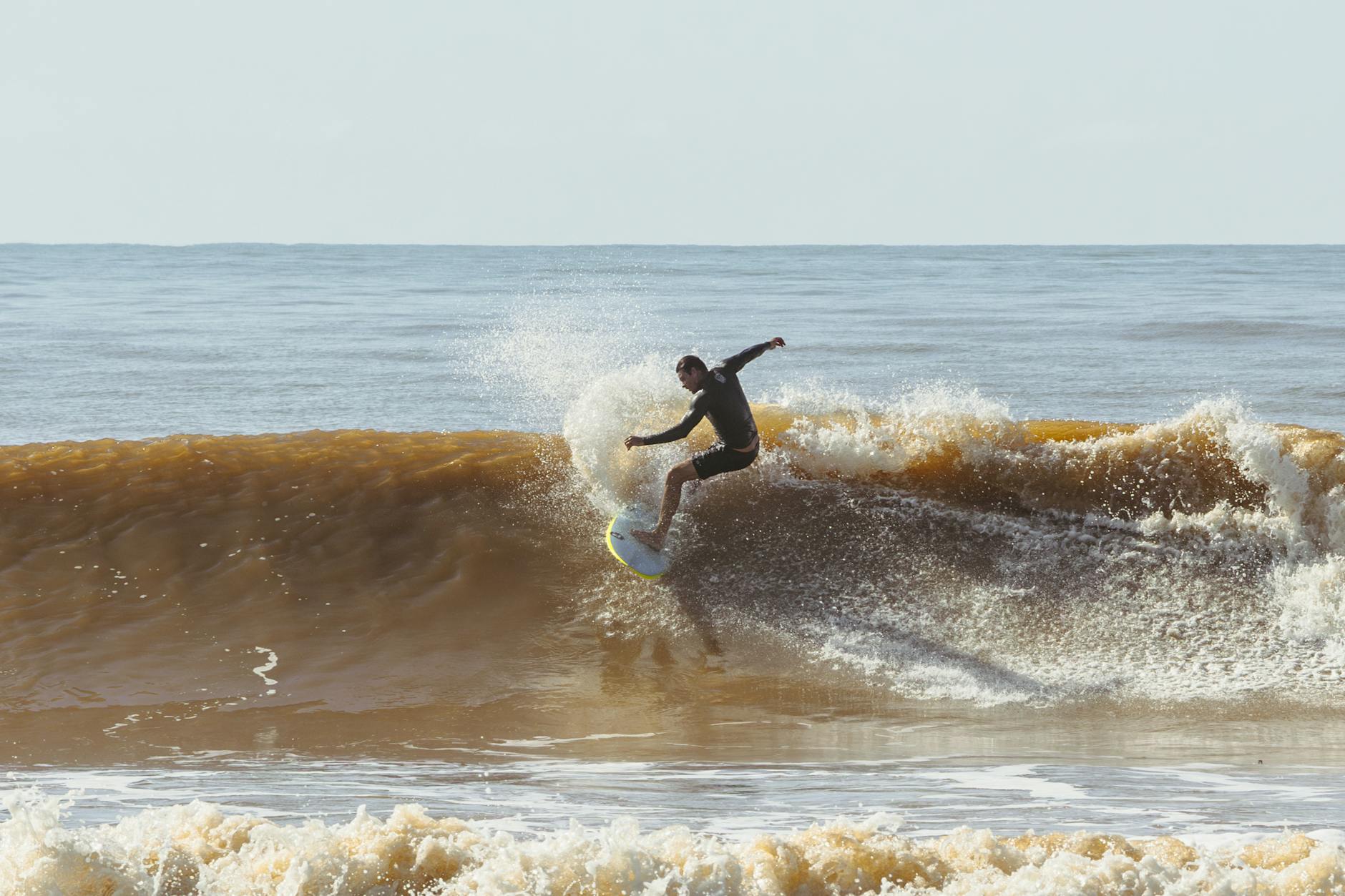
- White water practice. Your first waves will be in the white water — the broken, foamy part of the wave closest to shore. This is where beginners learn to stand up, and it’s more fun than it sounds. The white water is forgiving and gives you plenty of opportunity to try again quickly.
- Feedback and adjustment. A good instructor will watch your attempts and give you specific feedback. Don’t be embarrassed to ask questions or admit that something isn’t working.
- Cool down and debrief. Most schools finish with a brief discussion of what you’ve learned and what to focus on next time.
Don’t expect to be riding green waves on your first lesson. Very few people do. What you should expect is to stand up in the white water at least a few times, to have a genuine laugh, and to leave the water absolutely exhausted in the best possible way.
The Equipment Question: What Do You Actually Need?
One of the most sensible decisions any beginner over 40 can make is to hire equipment rather than buy it, at least for the first few months. The British surf industry is well-supplied with hire options, and committing to buying a board before you know whether you enjoy the sport is an expensive gamble.
When you do decide to buy, the first board for a beginner should be a longboard or a foam softboard — typically nine to ten feet in length. These boards are stable, buoyant, and much more forgiving of the mistakes every beginner makes. Ignore anyone who tells you to start on a shortboard. You will spend most of your time underwater and none of it actually surfing.
UK-based retailers worth knowing about include Tiki Surf, which has been supplying the British surf market for decades, and Surfdome, which stocks a wide range of beginner-friendly boards and accessories. Local surf shops in surf towns like Newquay, St Ives, and Croyde often have good second-hand boards too, and the staff will give you honest advice about what suits a beginner.
The wetsuit is non-negotiable in British waters. Even in summer, the sea temperature around most of the UK coastline sits between 14°C and 18°C — cold enough to cause discomfort and, without proper protection, eventually hypothermia. A good 4/3mm wetsuit (4mm thickness on the body, 3mm on the arms and legs) will serve you well through most of the UK surf calendar. Brands like O’Neill, Billabong, and Finisterre — the latter a Cornish company with a strong reputation for quality UK-specific wetsuits — are all solid choices.
How Over 40s Compare to Younger Beginners: An Honest Assessment
| Factor | Beginners Under 25 | Beginners Over 40 | Notes |
|---|---|---|---|
| Physical recovery | Faster recovery between sessions | Slower recovery; rest days more important | Build rest days into your schedule from the start |
| Flexibility | Generally greater natural flexibility | May be reduced; regular stretching helps significantly | Yoga or Pilates alongside surfing makes a real difference |
| Patience and focus | Variable; often inconsistent | Typically stronger; better at deliberate practice | A major advantage in early skill development |
| Risk awareness | Often underestimated; more prone to overconfidence | More measured approach to ocean safety | Maturity reduces the likelihood of dangerous decisions |
| Progression timeline | May progress to green waves slightly faster | Solid foundations often lead to consistent improvement | Comparison is largely unhelpful; surf at your own pace |
Looking After Your Body: The Bit Nobody Tells You
Sue, a physiotherapist from Bristol, took her first surf lesson at 47 on a trip to Croyde. She loved it immediately but made the mistake many beginners make: she went five days in a row without any real rest, and by day four her lower back was sending her clear signals to stop. “I treated it like I was twenty,” she said. “My body had other ideas.”
This is one of the most common problems for older beginners, and it’s entirely avoidable. Surfing uses muscles that most adults haven’t engaged seriously since childhood — the upper back, the rotator cuffs, the hip flexors, the core. Your first few sessions will leave you sore in places you didn’t know existed. This is normal. What isn’t normal, or at least isn’t sensible, is ignoring it.
A few practical habits that make a real difference:
- Warm up properly before every session. Ten minutes of dynamic stretching on the beach is not optional.
- Strengthen your paddling muscles between sessions. Simple shoulder and rotator cuff exercises, done consistently three times a week, will reduce injury risk significantly.