Budget Surfing in the UK: Getting Started Without Overspending
Budget Surfing in the UK: Getting Started Without Overspending
So you want to learn to surf but you’re worried about the cost? Good news: the UK has some of the finest surf in Europe, and getting started doesn’t have to drain your bank account. From the rugged coastlines of Cornwall to the wild beaches of Scotland’s north coast, world-class waves are waiting for you – and most of them are completely free to stand in front of. The trick is knowing where to spend your money and where to hold back.
This guide is written for absolute beginners who want to get into surfing without throwing hundreds of pounds at kit they don’t need yet, lessons they could do without, or holidays that cost more than they should. We’ll cover everything from your first lesson to buying second-hand boards, choosing the right wetsuit, and finding cheap places to stay near the surf.
Understanding the Real Costs of Learning to Surf
Before anything else, it helps to be honest about what surfing actually costs. A lot of beginners either massively overestimate the expense (and never start) or underestimate it (and get burned by poor choices early on). The truth sits somewhere in the middle.
The biggest upfront costs are lessons, a wetsuit, and eventually a board. But here’s the thing: you don’t need to buy a board on day one. In fact, buying a board before you know what you’re doing is one of the most common and expensive mistakes new surfers make.
What You Actually Need on Day One
On your very first surf session, you need precisely three things: a lesson from a qualified instructor, a board (which the school will provide), and a wetsuit (which the school will also usually provide). That’s genuinely it. You don’t need surf wax, a board bag, a leash, reef boots, or anything else sold in surf shops. Keep it simple at the start.
A Rough Cost Breakdown for Beginners
| Item | Budget Option | Mid-Range Option | Notes |
|---|---|---|---|
| Group surf lesson (2 hours) | £25-£35 | £40-£55 | Includes board and wetsuit hire |
| Wetsuit (second-hand) | £20-£50 | £60-£100 | Check eBay, Facebook Marketplace, local surf shops |
| Wetsuit (new) | £80-£120 | £150-£250 | Worth buying new if budget allows |
| Beginner foam board (second-hand) | £50-£100 | £120-£180 | Don’t buy new until you’re committed |
| Leash | £10-£15 (second-hand) | £20-£35 (new) | Safety essential – don’t skip this |
| Surf wax | £2-£4 | £4-£6 | Buy the correct grade for UK water temperatures |
| Weekend accommodation (near surf) | £15-£25/night (camping) | £40-£80/night (hostel/B&B) | Prices vary hugely by location and season |
Taking Your First Lessons Without Overpaying
Lessons are the one area where going too cheap can genuinely backfire. A poorly taught first lesson can leave you with bad habits that take months to unlearn, or worse, leave you feeling unsafe in the water. That said, you absolutely do not need to pay top prices – you just need to choose wisely.
Look for Surf Governing Body Accreditation
In the UK, the body that accredits surf instructors and schools is Surfing England (for England), Surf Wales, and Surfing Scotland. Any school worth your money will be affiliated with one of these organisations, and their instructors will hold a recognised coaching qualification – typically a Level 1 or Level 2 from the British Surfing Association (BSA). This accreditation matters because it means your instructor has been trained in water safety, first aid, and teaching technique. Always check before you book.
Surfing England, Surf Wales, and Surfing Scotland all maintain directories of approved schools on their websites. This is your first stop when researching lessons, not a quick Google search that may surface schools with no credentials at all.
Group Lessons vs Private Lessons
For beginners, group lessons are almost always the better value. You’ll pay significantly less and, honestly, at this stage you’re mostly learning on the beach and in the white water – you don’t need one-to-one attention the whole time. A typical group lesson runs for around two hours and will cover beach safety, surf etiquette, paddling technique, and your first attempts to stand up on the board. That’s an excellent introduction for £25-£35.
Private lessons start around £60-£80 per hour and are worth it later on when you’re stuck on something specific – but save that investment for when you actually know what you need to work on.
Surf Schools Near Popular UK Spots
There are well-regarded surf schools at nearly every major UK surf beach. Newquay in Cornwall has dozens of options, as does Croyde in North Devon. Further afield, you’ll find schools at Freshwater West in Pembrokeshire, Saltburn-by-the-Sea in North Yorkshire, Belhaven Bay in East Lothian, and Thurso in the far north of Scotland. Prices tend to be lowest in areas where competition is highest – which means Newquay is actually quite competitive despite being the most famous surf town in the UK.
Buying Your First Wetsuit Without Getting Ripped Off
If there’s one piece of kit that’s genuinely worth owning from fairly early on, it’s a wetsuit. Hiring one from a surf school every single time gets expensive quickly, and a hired wetsuit is never quite as comfortable or well-fitted as your own. UK water temperatures also mean you’ll be in a wetsuit every single session – this isn’t somewhere you can get away with board shorts and a rash vest.
Understanding UK Water Temperatures
UK sea temperatures vary from around 7-8°C in winter (in Scotland, it can be lower) to roughly 16-18°C in summer in the south-west of England. This means you need a proper wetsuit, not a shorty. For most of the year, a 4/3mm full-length wetsuit is the workhorse of UK surfing. In winter, a 5/4mm or even 6/5mm suit is recommended, along with wetsuit boots, gloves, and a hood. In high summer in Cornwall, a 3/2mm can be comfortable, but a 4/3mm will serve you year-round.
Where to Find a Good Second-Hand Wetsuit
Second-hand wetsuits are everywhere and can be outstanding value. Check eBay, Facebook Marketplace, and Gumtree first. Local surf shop noticeboards (many shops in Newquay, Croyde, and Porthcawl have these) are also excellent sources. Look for suits that are no more than two or three years old, have no significant tears or missing seams, and don’t smell strongly of neoprene degradation. A budget of £30-£60 should get you a perfectly serviceable second-hand 4/3mm.
If you’re buying new, brands like Billabong, O’Neill, and Rip Curl all produce entry-level suits in the £80-£120 range that will last a beginner several seasons with reasonable care. Rinse your wetsuit in fresh water after every session – this single habit will extend its life enormously.
Getting Your First Board Without Breaking the Bank
Here’s a rule of thumb that experienced surfers repeat constantly to beginners: bigger is almost always better when you’re starting out. A large, wide, thick foam board (commonly called a foamie or a soft-top) is far easier to catch waves on, far more forgiving when you fall, and far safer to those around you than a sleek, narrow shortboard. The shortboard that looks cool in surf videos is genuinely one of the hardest surfboards to learn on.
The Case for a Foam Board
Foam boards – sometimes called Morey Boogie-style soft-tops – are specifically designed for beginners, and they’re brilliant at their job. Look for something in the 8- to 9-foot range. These boards paddle easily, give you a generous platform to stand on, and don’t hurt nearly as much when they hit you (which they will). Brands like Wavestorm, BIC, and Softech produce decent foam boards, and second-hand examples turn up constantly on Facebook Marketplace for £50-£100.
Where to Buy Second-Hand Boards in the UK
Facebook Marketplace is without question the best place to find second-hand boards in the UK right now. Search within 30 miles of any surf town and you’ll usually find multiple listings. Gumtree is a close second. Local surf shops often have second-hand boards stacked outside too – it’s always worth asking even if nothing is displayed. The Surfing England and Surf Wales community forums occasionally have boards listed as well.
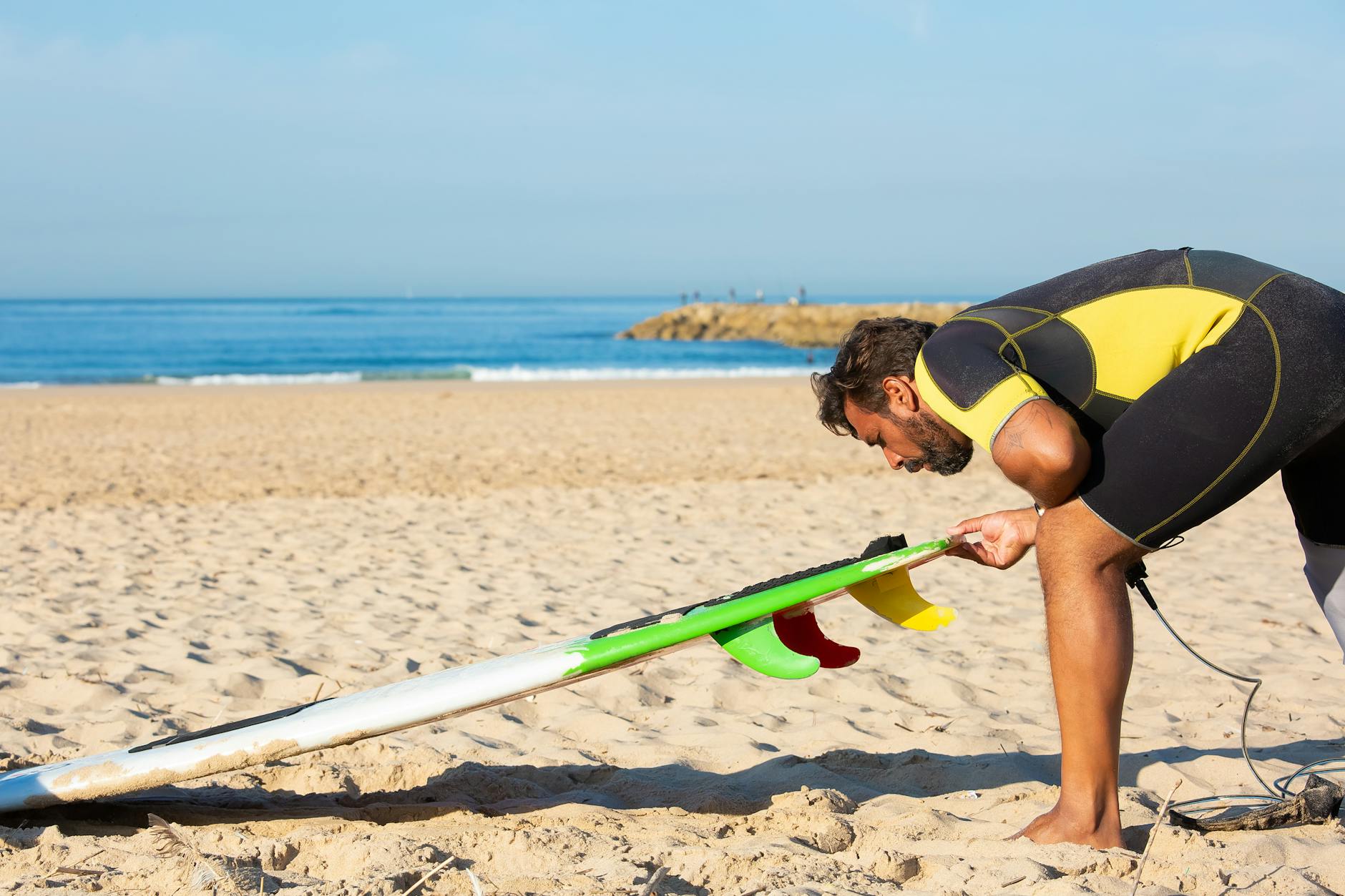
When inspecting a used board, run your hands over the entire surface looking for soft spots (which indicate water damage), check the fins are present and undamaged, make sure the leash plug is intact, and look at the nose and tail for significant dings. A few cosmetic marks are fine and should be used to negotiate the price down. Structural damage is a reason to walk away.
Timing Your Purchase
The end of summer is the absolute best time to buy second-hand surf kit. Every September, a wave of people who had good intentions during the summer – and bought boards to match – list their barely-used equipment online at reduced prices. If you can hold off until autumn to buy a board, you’ll get considerably better value than buying in spring.
Choosing Where to Surf on a Budget
The good news about UK surfing locations is that the ocean itself is free. There are no fees to use the beach, no access charges for the waves, and no membership costs to stand in the sea. The costs associated with location come from getting there and staying nearby – and this is where a bit of planning makes a significant difference.
Cornwall: Famous but Not Always Expensive
Cornwall is the heartland of UK surfing. Newquay, Perranporth, Sennen Cove, Porthleven, and St Agnes all offer excellent surf beaches. Newquay in particular has a huge range of accommodation options including hostels, campsites, and budget B&Bs. Fistral Beach is probably the most famous surf beach in the
UK, and while the town itself can get busy and pricey in peak summer, there are quieter spots nearby that cost considerably less to reach and stay near. Camping in particular is a strong option in Cornwall — sites around Newquay, St Agnes, and the Lizard Peninsula regularly offer pitches for under £15 a night, which keeps costs manageable even over a long weekend. Travelling outside of July and August makes a substantial difference too; spring and autumn swells are often better anyway, and accommodation prices can drop by half.
Wales and Beyond: Overlooked and Affordable
The Gower Peninsula and Pembrokeshire in Wales offer genuinely world-class surf without the crowds or prices that come with Cornwall in high season. Llangennith on the Gower is a favourite among Welsh surfers — a long, consistent beach break with a campsite right behind the dunes that charges reasonable rates. Pembrokeshire’s Freshwater West and Newgale are similarly uncrowded and well worth the drive. Scotland’s north coast, particularly around Thurso, attracts experienced surfers chasing cold-water reef breaks, and the remoteness keeps costs low simply because there is far less tourist infrastructure to pay for. Yorkshire and Northumberland also have underrated beach breaks, and accommodation in those areas tends to be significantly cheaper than the south-west.
Getting There Without Spending a Fortune
A car is the most practical way to access surf spots in the UK, and splitting fuel costs between two or three people makes a significant difference. Surf trip carpooling is common in the community — local surf clubs and online forums are a reasonable place to find others heading in the same direction. If a car is not an option, several surf spots in Cornwall and Wales are reachable by train and bus, though the last mile to the beach can be awkward with a board. A second-hand soft-top board is also worth considering for travel, as it is lighter, cheaper to replace if damaged, and less of a worry to strap to a roof rack or stuff into a van.
Final Thoughts
Surfing in the UK does not require a large budget, an exotic destination, or expensive lessons from a private coach. The essentials — a decent wetsuit, a suitable board, and a stretch of open beach — are all achievable without significant outlay, particularly if you buy second-hand, travel in a group, and avoid the peak summer rush. The sea is free, the learning curve is part of the experience, and the UK coastline offers more variety than most people expect. Getting started is largely a matter of keeping it simple and spending sensibly rather than chasing gear or locations you do not yet need.