Learning to Surf in the UK: What Beginners Need to Know
Learning to Surf in the UK: What Beginners Need to Know
So You Want to Surf in Britain?
Most people picture surfing as something that happens in California, Hawaii, or Australia — somewhere warm, exotic, and reliably sunny. The idea of learning to surf in the UK, with its grey skies and famously unpredictable weather, might seem a little optimistic. But here is the thing: Britain has some genuinely world-class surf. Cornwall, Wales, Scotland, and the North Devon coast produce waves that attract experienced surfers from across Europe, and those same coastlines are also home to dozens of excellent surf schools that teach absolute beginners every single week of the year.
If you have been curious about surfing but assumed it was not really a British pursuit, this guide is here to change your mind. We will cover where to go, what to expect, what gear you need, how to stay safe, and how to actually get better once you have had your first lesson. No fluff, no nonsense — just practical advice from someone who knows these waters well.
Where to Learn: The Best Beginner Spots in the UK
Location matters enormously when you are starting out. You want consistent, manageable waves — not the heavy, powerful surf that experienced surfers seek out. Fortunately, the UK has plenty of spots that tick that box.
Cornwall is probably the first place most people think of, and for good reason. Perranporth, Polzeath, Sennen Cove, and Croyde (just over the border into Devon) are all fantastic for beginners. They offer sandy-bottomed beaches, relatively forgiving waves, and a well-established surf school infrastructure. Newquay in particular has become something of the UK’s surf capital — it has more surf schools per square mile than almost anywhere else in the country, which means plenty of competition keeps the quality high.
Wales is often overlooked but is genuinely brilliant for beginners. The Gower Peninsula in South Wales, particularly Llangennith beach, offers long stretches of sand and consistent Atlantic swell. Pembrokeshire also has some excellent beginner-friendly spots, and the Welsh surf scene tends to feel a little less crowded and commercialised than parts of Cornwall.
Scotland is a different proposition entirely — the waves can be extraordinary, but the water is cold and the conditions less forgiving. Places like Thurso and the Outer Hebrides produce world-class surf, but these are not beginner destinations. That said, the west coast of Scotland and parts of the Aberdeenshire coastline do have gentler options if you fancy a proper adventure and are happy dealing with cold water.
Yorkshire and the North East are less glamorous but surprisingly good. Scarborough, Saltburn-by-the-Sea, and Tynemouth all have active surf communities and decent beginner waves, particularly during autumn swells. If you live in the north of England, these are far more accessible than Cornwall and absolutely worth considering.
Taking Your First Lesson: What to Expect
Before you buy a single piece of kit, book a lesson with a qualified surf school. This is not optional advice — it is genuinely the most important thing a beginner can do. Trying to teach yourself from YouTube videos is a quick way to develop bad habits, miss out on key safety information, and have a frustrating time in the water.
Look for surf schools that employ coaches certified by Surfing England, Surf Wales, or Surfing Scotland — the national governing bodies that set coaching standards across the country. Instructors with these qualifications have been trained not just in surf technique but also in beach safety, first aid, and water rescue. It is worth checking this before you book rather than assuming every school meets the same standard.
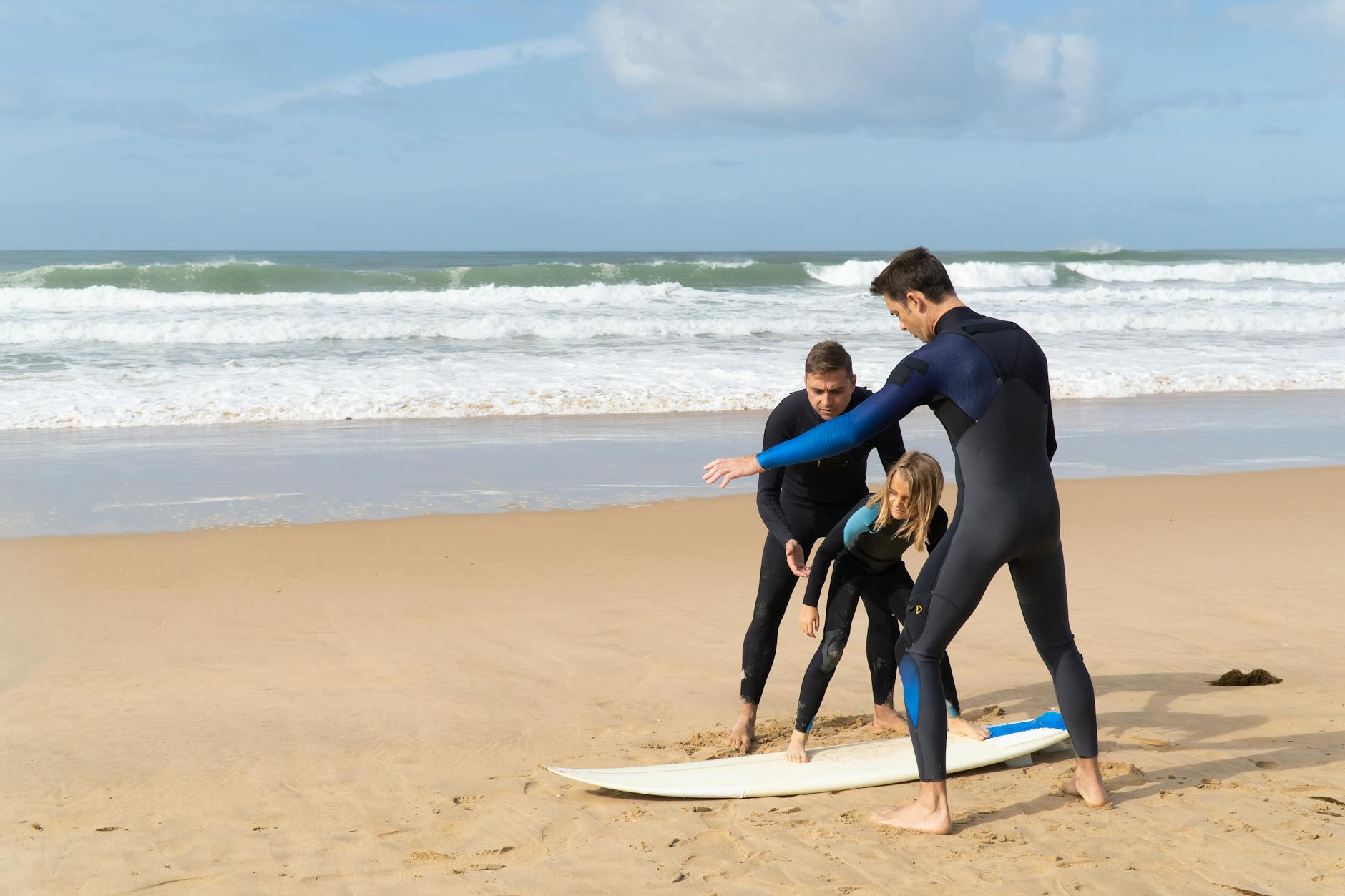
A typical beginner group lesson lasts around two hours and usually follows a similar structure. You will spend time on the beach going through the basics — how to lie on the board, how to paddle, how to read a wave, and the all-important pop-up technique (standing up from lying down in one fluid movement). Then you will head into the water in a group, usually in the whitewater close to shore, where your instructor will guide you into waves and help you find your feet. Most people manage to stand up at least once in their first session, even if it does not look pretty.
Group lessons are typically priced between £35 and £55 per person in the UK. Private lessons cost more but are genuinely worth considering if you want faster progression or feel self-conscious in a group setting. Many schools also offer multi-day packages that represent good value if you are staying in the area for a few days.
Essential Gear for UK Surfers
Surfing in the UK means surfing in cold water. Even in the height of summer, sea temperatures around Cornwall and Wales rarely climb above 18°C, and in Scotland or the North Sea they can stay below 10°C for much of the year. A good wetsuit is not a luxury here — it is an absolute necessity.
For most UK conditions, you will want a 5/4mm or 4/3mm full wetsuit. The numbers refer to the thickness of the neoprene in millimetres — thicker in the body (5mm or 4mm) and slightly thinner in the limbs (4mm or 3mm) to allow movement. In summer, particularly in Cornwall or Wales, a 3/2mm suit can work fine. In winter, especially in northern waters, you will also want wetsuit boots, gloves, and a hood — surfing in January off the Yorkshire coast without gloves is an experience you will not want to repeat.
UK brands and retailers worth knowing include Finisterre (based in St Agnes, Cornwall, with a strong focus on sustainability and cold-water performance), Osprey (a solid budget-friendly option widely available online and in high street surf shops), and O’Neill, Rip Curl, and Billabong, all of which have good UK stockists. Many surf shops along the Cornish and Welsh coastlines also stock second-hand wetsuits, which can be a cost-effective option when you are just starting out.
As for the board itself, do not rush out and buy one straight away. Most beginners should be using a foam board (also called a foamie or a soft-top) for their first several months of surfing. These boards are longer, wider, and more buoyant than the fibreglass shortboards you see in films, which makes them far easier to paddle, balance on, and catch waves with. They are also much more forgiving when they hit you — and they will hit you. Your surf school will provide boards for your lessons, and many shops along surfing coastlines offer daily hire so you can keep practising between lessons without committing to a purchase.
Understanding UK Beach Safety and Rules
British beaches are managed differently from those in many other countries, and there are a few things every beginner surfer needs to know before getting in the water.
Surf between the flags. On many popular UK beaches, the RNLI (Royal National Lifeboat Institution) lifeguards operate during the summer season and mark out a designated bathing zone with red and yellow flags. This zone is for swimmers only — surfers must stay outside it. Look for the black and white chequered flags, which mark the designated surfing area. If there are no flags and no lifeguards, use your judgement and common sense about where to position yourself.
The RNLI has a strong presence on Cornish, Devonian, and Welsh beaches from late May to September, and some beaches extend their patrol season into October. Outside of these times, many popular surf beaches are unpatrolled, so you need to be more careful about assessing conditions yourself.
Rip currents are the most significant hazard for beginners on UK beaches. A rip is a channel of water moving away from the shore, and it can pull even a strong swimmer out to sea surprisingly quickly. Rips are often visible as a darker, choppier patch of water between breaking waves. If you find yourself caught in one, the most important thing to remember is: do not panic and do not try to swim directly back to shore against the current. Instead, swim parallel to the beach until you are out of the rip, then make your way back in.
Your surf instructor will cover rip safety in your lesson, but it is worth reading up on it independently too. The RNLI website has excellent free resources on beach safety and rip current identification.
Surf Etiquette: Unwritten Rules That Matter
Surfing has its own code of conduct, and while nobody is going to hand you a rulebook at the water’s edge, understanding the basics will make you a safer and more respectful surfer from day one.
- Right of way goes to the surfer closest to the peak. The peak is the point where the wave is highest and first breaking. If someone is already riding a wave, do not drop in (paddle into the same wave in front of them). This is the cardinal rule of surfing and breaking it causes accidents as well as serious ill feeling.
- Do not ditch your board. When a wave comes and you are not ready, the instinct is to bail and dive under the water. In an uncrowded spot this may be fine, but on a busy beach your board becomes a dangerous projectile. Learn to control it, and always check behind you before you paddle out or turn around.
- Communicate. If you are going left and someone else is going right on the same wave, shout it out. A quick “going left!” avoids a lot of collisions.
- Wait your turn. On busy days at popular breaks, there is an informal queue system. Paddle out, wait, and take your
turn when it comes. Cutting in, known as snaking, is considered very poor form and will not make you popular in the water.
One habit worth developing early is watching the sea before you get in. Spend ten minutes on the beach observing where waves are breaking, where the rip currents are running, and how other surfers are moving around the line-up. This saves energy, reduces risk, and gives you a much clearer picture of what you are about to paddle into. Most experienced surfers do this automatically, even after years in the water. It costs nothing and it can prevent a bad situation before it starts.
It is also worth being honest with yourself about your ability on any given day. A beach that was manageable last weekend can be a different place entirely when a larger swell arrives or the wind picks up. Check the forecast using a reliable surf report, speak to the lifeguards if they are on duty, and do not be too proud to sit a session out if conditions are beyond your current level. Progression in surfing is not linear, and there is no shame in choosing the smaller wave or the calmer day.
Getting Started
The most straightforward way to begin is to book a lesson with a qualified British Surfing Association instructor. Lessons are widely available across Cornwall, Devon, Wales, and the north-east coast of England. A good instructor will cover water safety, how to read a wave, and the basics of popping up to your feet in a controlled environment. From there, hiring a board and getting time in the water consistently matters far more than buying expensive equipment early on. Progress comes through repetition, patience, and a willingness to look foolish while you find your feet. The UK coastline, for all its cold water and grey skies, offers a genuinely rewarding place to learn, and on the right day, with the right wave, it is difficult to be anywhere else.